1. Introduction to the K53 Test
The K53 learner's licence test is a computer-based examination administered at any South African traffic department. It is the first step to obtaining your driver's licence and tests your theoretical knowledge of road rules, road signs, and vehicle controls.
Test Structure
The test consists of three separate sections, each of which must be passed independently:
- Road Rules — 30 questions covering speed limits, right of way, overtaking, following distance, parking, towing, and general traffic law.
- Road Signs — 30 questions on regulatory, warning, information, guidance, and temporary signs, as well as road markings.
- Vehicle Controls — 8 questions on dashboard instruments, pedals, mirrors, levers, and warning lights.
That gives you a total of 68 questions across all three sections.
Pass Mark
You must achieve at least 77% in each individual section to pass the test. This is extremely important to understand: your scores are not combined into an overall average. If you score 100% in Road Rules and 100% in Vehicle Controls but only 76% in Road Signs, you fail the entire test and must rewrite all three sections.
Test Format
- The test is multiple choice and conducted on a computer terminal.
- You will see one question at a time with several possible answers.
- You have approximately 60 minutes to complete all three sections.
- The test is available in all 11 official South African languages: Afrikaans, English, isiNdebele, isiXhosa, isiZulu, Sepedi, Sesotho, Setswana, siSwati, Tshivenda, and Xitsonga.
Cost and Booking
The test fee is approximately R78, though you should verify the current fee with your local traffic department as it may vary. To book, visit your nearest traffic department in person or book online where the service is available. Some centres accept walk-ins, but booking in advance is strongly recommended to avoid long wait times.
2. Vehicle Controls
The vehicle controls section tests your knowledge of the instruments, pedals, levers, and mirrors inside a car. You need to be able to identify each control and explain its function. Study the diagram below and learn all 12 numbered controls.
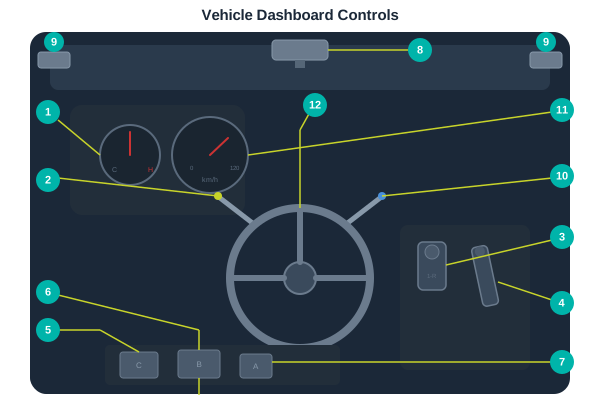
The 12 Dashboard Controls
1. Temperature Gauge
Located on the instrument cluster, the temperature gauge monitors the engine coolant temperature. Under normal driving conditions, the needle should sit in the middle range. If the needle moves into the red zone, it means the engine is overheating. You must stop the vehicle immediately, switch off the engine, and allow it to cool down. Continuing to drive with an overheating engine can cause severe and expensive damage.
2. Indicator / Turn Signal Lever
The indicator lever is located on the left side of the steering column. Push the lever down to indicate a left turn, and push it up to indicate a right turn. The indicator will automatically cancel after the turn is completed. Always signal your intention well in advance to give other road users time to react.
3. Gear Lever
The gear lever is located on the centre console between the driver and passenger seats. In a manual vehicle, it is used together with the clutch pedal to change gears. Most manual cars have five forward gears (1 through 5) and one reverse gear. First gear is used for moving off, while higher gears are selected as speed increases.
4. Handbrake / Parking Brake
The handbrake (also called the parking brake) prevents the vehicle from rolling when it is stationary. You should always engage the handbrake whenever the vehicle is parked, whether on a flat surface or a hill. To release it, press the button on the handle and lower the lever. In the K53 driving test, you are also expected to engage the handbrake when stopped at a traffic light.
5. Clutch Pedal
The clutch pedal is the far left pedal in a manual vehicle. Pressing it disconnects the engine from the gearbox, allowing you to change gears without grinding them. The clutch must be pressed fully before selecting a new gear, then released smoothly to re-engage the engine with the wheels. Riding the clutch (keeping it partially pressed while driving) causes excessive wear.
6. Brake Pedal
The brake pedal is the middle pedal. Press it to slow down or bring the vehicle to a complete stop. Apply the brake smoothly and progressively rather than slamming it down, which can cause the wheels to lock and the vehicle to skid. In vehicles with ABS (anti-lock braking system), maintain firm pressure on the brake pedal and let the system prevent wheel lock-up.
7. Accelerator Pedal
The accelerator pedal (also called the gas pedal or throttle) is the far right pedal. Pressing it increases engine speed and makes the vehicle move faster. Use it gently and progressively. Harsh acceleration wastes fuel and reduces tyre grip, especially in wet conditions.
8. Rearview Mirror
The rearview mirror is mounted at the top centre of the windscreen. It provides a view of the traffic behind you through the rear window. You should check it regularly while driving, before braking, and before changing lanes. Adjust it so you can see the entire rear window without moving your head.
9. Side Mirrors
The side mirrors (also called wing mirrors) are located on the left and right sides of the vehicle. They show traffic in adjacent lanes and help eliminate blind spots. The left mirror should be adjusted so you can just see the side of your own vehicle, with the horizon roughly in the centre. The right mirror is adjusted the same way. Always check your side mirrors before turning, changing lanes, or overtaking.
10. Windscreen Wipers
The windscreen wiper lever is usually located on the right side of the steering column. It activates the wipers to clear rain, water, or debris from the windscreen. Most vehicles have multiple speed settings (intermittent, slow, fast) and a washer function that sprays cleaning fluid onto the windscreen. Use your wipers whenever visibility is reduced by rain or mist.
11. Speedometer
The speedometer is part of the instrument cluster, typically on the right side. It displays the current speed of the vehicle in kilometres per hour (km/h). You must monitor the speedometer regularly to ensure you are not exceeding the posted speed limit. Most speedometers also include an odometer, which records the total distance the vehicle has travelled.
12. Steering Wheel
The steering wheel controls the direction of the vehicle. Hold it with both hands in the "ten-to-two" or "quarter-to-three" position for maximum control. Turn it smoothly and avoid crossing your arms. The steering wheel may also house the horn button (in the centre) and airbag.
Automatic vs Manual Vehicles
The main difference between an automatic and a manual vehicle is the transmission. An automatic car has no clutch pedal — there are only two pedals: the brake (left) and the accelerator (right). The gear lever in an automatic vehicle has positions labelled P (Park), R (Reverse), N (Neutral), and D (Drive). The car changes gears on its own as you accelerate and decelerate.
Warning Lights
Your vehicle's dashboard has several warning lights that alert you to potential problems. You should know what each one means:
- Oil Pressure Warning (red oil can icon) — This means oil pressure is dangerously low. Stop immediately and switch off the engine. Driving without oil pressure will destroy the engine within minutes.
- Battery / Charging Warning (red battery icon) — Indicates an alternator fault. The battery is not being charged. The vehicle will eventually lose electrical power and stop. Have it checked as soon as possible.
- Engine Check / Malfunction (amber engine icon) — The engine management system has detected a fault. The vehicle can usually still be driven, but you should have it checked by a mechanic promptly.
- ABS Warning (amber ABS text) — The anti-lock braking system has a fault. Normal brakes still work, but ABS assistance is unavailable. Have it checked by a mechanic.
- Seatbelt Reminder (red seatbelt icon) — Reminds the driver or passenger to fasten their seatbelt. Wearing a seatbelt is compulsory by law for the driver and all passengers.
- Fuel Warning (amber fuel pump icon) — The fuel level is low. Refuel as soon as possible to avoid running out of petrol or diesel.
3. Road Signs
Road signs are one of the most challenging sections of the K53 test. You need to learn a large number of signs and understand not only what they look like but also what they mean and how to respond to them. The good news is that South African road signs follow a logical system based on colour and shape.
The Colour System
- Red — Prohibition or danger. Red is used for regulatory signs that forbid certain actions (no entry, no overtaking) and for warning sign borders.
- Blue — Mandatory or compulsory. Blue signs tell you what you must do (keep left, minimum speed, pedestrians only).
- Yellow — Temporary or warning. Yellow backgrounds are used for temporary signs at roadworks. These override permanent signs.
- Green — Guidance and direction. Green signs show directions to towns, distances, and freeway information.
The Shape System
- Circle — Regulatory signs. Circles with a red border prohibit actions; circles with a blue background command actions.
- Triangle — Warning signs. Triangles with a red border and white background warn you of hazards ahead.
- Rectangle / Square — Information signs. These provide useful information such as parking, hospital, or filling station locations.
- Octagon — Exclusively used for the STOP sign.
- Diamond — Indicates a priority road (you have right of way).
A) Regulatory Signs
Regulatory signs are circular with a red border on a white background. They indicate rules that must be obeyed. Breaking a regulatory sign is a traffic offence.
- Stop Sign — A red octagon with the word STOP in white. You must bring your vehicle to a complete stop behind the stop line, check that it is safe, and then proceed. Rolling through a stop sign is illegal.
- Yield Sign — An inverted white triangle with a red border. You must slow down and give way to all traffic that has right of way. You may proceed without stopping only if there is no conflicting traffic.
- No Entry — A red circle with a horizontal white bar. You are not allowed to enter the road or lane displaying this sign.
- Speed Limit Signs — A red circle with a number inside (e.g., 60, 80, 100, 120). The number indicates the maximum speed in km/h that you are allowed to travel on that road.
- No Overtaking — A red circle with two cars side by side (one red, one black). You may not overtake any vehicle while this sign is in effect.
- No Parking — A red circle with a diagonal red line over a blue background. Parking is not allowed in the area indicated by the sign.
- Keep Left — A blue circle with a white arrow pointing left. You must pass on the left side of the obstacle or island.
- Keep Right — A blue circle with a white arrow pointing right. You must pass on the right side of the obstacle or island.
B) Warning Signs
Warning signs are triangular with a red border and a white background. They alert you to hazards ahead so you can adjust your driving accordingly. They do not give commands — they provide advance notice.
- Slippery Road — Shows a car with skid marks. The road surface ahead may be slippery, especially when wet. Reduce speed.
- T-Junction Ahead — The road you are travelling on ends at a T-junction. You will need to turn left or right.
- Crossroad Ahead — A cross symbol inside the triangle. An intersection is ahead where traffic may cross your path.
- Y-Junction Ahead — The road ahead splits into two. Choose your direction and signal in advance.
- Narrow Bridge — The road narrows at a bridge. Oncoming traffic may be very close. Reduce speed and proceed with caution.
- Gravel Road — The road surface changes to gravel ahead. Reduce speed significantly to maintain control.
- Sharp Curves — The road ahead has one or more sharp bends. Slow down before entering the curve, not while in it.
- Pedestrian Crossing — Pedestrians may be crossing the road ahead. Slow down and be prepared to stop.
C) Information Signs
Information signs are rectangular and provide useful information to drivers. They do not give commands or warnings.
- Parking (blue P) — A blue square with a white letter P. Indicates that parking is permitted in the area.
- Hospital (blue H) — A blue rectangle with a white H. Indicates a hospital is nearby. Expect slow-moving traffic, ambulances, and pedestrians.
- Filling Station — A blue rectangle with a fuel pump icon. A petrol station is nearby.
- Priority Road (yellow diamond) — A yellow diamond shape. Indicates you are on a priority road and have right of way over joining traffic at upcoming intersections (unless otherwise indicated).
D) Guidance Signs
Guidance signs have a green background with white text. They provide information about directions, distances, and routes.
- Direction Boards — Large green signs showing town names and arrows indicating which direction to travel. They are placed before interchanges and junctions.
- Freeway Countdown Markers — Green boards with white diagonal bars. Three bars mean 300 metres to the exit, two bars mean 200 metres, and one bar means 100 metres. These help you prepare for your exit in advance.
- Chevron Signs — Rectangular signs with arrows placed on sharp curves to show the direction of the bend. Multiple chevrons in a row indicate the severity of the curve.
E) Temporary Signs
Temporary signs have a yellow background and are used at roadworks and construction zones. The most important rule about temporary signs is this:
Temporary signs always override permanent signs. If a permanent speed limit sign says 120 km/h but a temporary yellow sign says 60 km/h, you must obey the 60 km/h limit. Temporary signs are placed for your safety and must be respected at all times.
F) Road Markings
Road markings are painted lines and symbols on the road surface. They are just as important as road signs and must be obeyed. Study the diagram below:
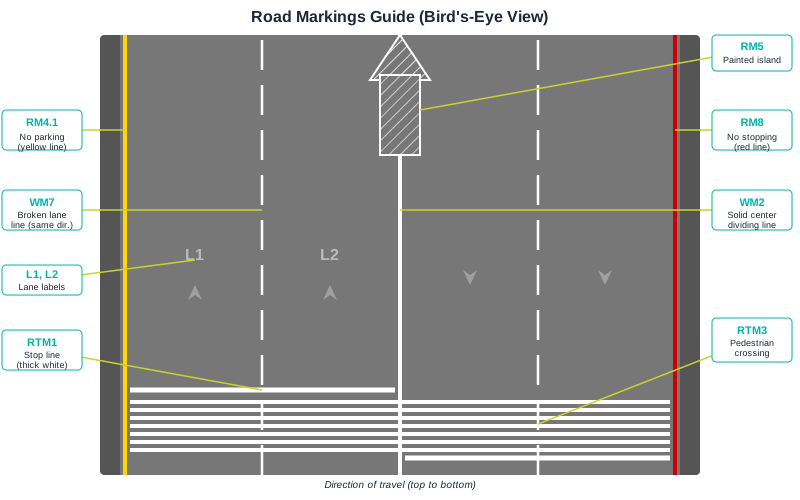
- Red Line (RM8) — No stopping at any time. You may not stop your vehicle alongside a red line for any reason, even briefly.
- Yellow Line (RM4.1) — No parking. You may stop briefly (e.g., to drop off a passenger) but you may not park and leave your vehicle.
- Solid White Centre Line (WM2) — No crossing or overtaking. You may not cross this line under any circumstances. It separates traffic flowing in opposite directions on a road where overtaking is dangerous.
- Broken White Line (WM7) — You may cross this line when it is safe to do so, for example to overtake a slower vehicle. Always check that it is safe before crossing.
- Painted Island (RM5) — A hatched or shaded area on the road. You may not drive on a painted island. It is used to separate traffic streams or to provide a safety buffer zone.
- Stop Line (RTM1) — A solid white line painted across your lane at an intersection. You must stop with the front of your vehicle behind this line. Do not stop on or past the line.
- Pedestrian Crossing (RTM3) — White zebra stripes painted across the road. Pedestrians have right of way on these crossings. You must stop for any pedestrian who is on the crossing or waiting to cross.
4. Rules of the Road
The rules of the road section is the largest part of the K53 test with 30 questions. It covers a wide range of topics including speed limits, right of way, following distance, overtaking, and parking rules. Study each sub-topic thoroughly.
A) The Golden Rule
The most important rule in South African traffic law is:
"Keep left as far as it is safe."
South Africa drives on the left side of the road. You must always keep as far left as is safely possible. The right lane on a multi-lane road is for overtaking only. After overtaking, return to the left lane. This rule applies on all roads, from suburban streets to national freeways.
B) Speed Limits
The default speed limits in South Africa are determined by the type of road you are driving on:
| Road Type | Speed Limit |
|---|---|
| Urban / Built-up area | 60 km/h |
| Rural / Non-urban road | 100 km/h |
| Freeway / National road | 120 km/h |
Always obey posted speed limit signs, as they may differ from the defaults. You should also reduce your speed in rain, fog, near schools, and in residential areas, even if the posted limit is higher.
C) Right of Way
Understanding right of way is crucial for both the test and real-world driving. Here are the key rules:
- Four-way stops: The first vehicle to arrive at the intersection and come to a complete stop has the right to go first. If two vehicles arrive at the same time, you must yield to the vehicle on your right.
- Traffic circles (roundabouts): You must yield to traffic that is already in the circle. When exiting the circle, signal left. If you are going straight through, no entry signal is needed, but signal left as you pass the exit before yours.
- Yield signs: Give way to all traffic. You may proceed without stopping only if there is a safe gap in traffic.
- Unmarked intersections: Where there are no signs or signals, yield to traffic approaching from your right.
- Emergency vehicles: When you hear sirens or see flashing lights from an emergency vehicle (ambulance, fire engine, police), you must pull over to the left side of the road and stop until the vehicle has passed.
- Pedestrians: Pedestrians always have the right of way at designated pedestrian crossings. Even when the traffic light is green for vehicles but a pedestrian has already started crossing, you must wait for them to finish crossing safely.
D) Following Distance
Maintaining a safe following distance gives you enough time to react if the vehicle ahead brakes suddenly. The standard rule is the two-second rule:
- Pick a fixed point on the road ahead (a sign, pole, or marking).
- When the vehicle in front of you passes that point, start counting: "one thousand one, one thousand two."
- If you reach the same point before finishing the count, you are following too closely.
You should increase your following distance in the following situations:
- During rain, fog, or poor visibility
- When driving at night
- When following heavy vehicles or trucks (they block your forward vision and take longer to stop)
- On gravel roads or slippery surfaces
Tailgating (following too closely) is both dangerous and illegal. It is one of the leading causes of rear-end collisions in South Africa.
E) Overtaking
Overtaking is one of the most dangerous manoeuvres on the road. You should only overtake when it is both safe and legal to do so.
You may NEVER overtake:
- On a solid white line
- When approaching a blind rise (hill crest where you cannot see oncoming traffic)
- When approaching a curve or bend where visibility is limited
- Near a pedestrian crossing
- At or near an intersection
The correct overtaking procedure:
- Check your rearview mirror to ensure no vehicle is overtaking you.
- Check your right-side mirror.
- Signal right.
- Check your blind spot by glancing over your right shoulder.
- If it is safe, move to the right and overtake the vehicle.
- Signal left.
- Check your left-side mirror and return to the left lane when safely clear of the vehicle.
When being overtaken: Move as far left as safely possible. Do not accelerate or try to prevent the other vehicle from passing. Maintain a steady speed or slow down slightly to make the overtaking manoeuvre quicker and safer.
F) Stopping and Parking Rules
There are strict rules about where you may and may not park or stop your vehicle. These are commonly tested on the K53 exam:
- No parking within 1.5 metres of a fire hydrant.
- No parking within 9 metres of a pedestrian crossing.
- No parking within 6 metres of an intersection.
- No parking on a two-way road that is less than 5.5 metres wide.
- No stopping within 5 metres of a bridge.
Emergency triangle: If your vehicle breaks down or you are forced to stop on the road, you must place a warning triangle at least 45 metres behind your vehicle to alert approaching traffic. On a freeway, place it further back if possible.
Parking on a hill:
- Facing downhill: Turn your front wheels toward the kerb. If the vehicle rolls, the kerb will stop it.
- Facing uphill: Turn your front wheels away from the kerb. If the vehicle rolls back, the wheels will catch against the kerb.
- In both cases, engage the handbrake and leave the vehicle in gear (first gear facing uphill, reverse facing downhill).
G) Other Important Rules
- Towing: When towing another vehicle, the distance between the two vehicles must not exceed 3.5 metres. Use a rigid tow bar or strong tow rope and ensure both vehicles display hazard warning lights.
- Headlights: You must dip (dim) your headlights when you are within 45 metres of an approaching vehicle. Failing to dip your headlights can temporarily blind the oncoming driver and is extremely dangerous.
- Lane changing: The correct procedure is: mirror, signal, blind spot check, then move. Never change lanes without completing all three checks.
- Minimum tyre tread depth: The legal minimum tyre tread depth is 1 mm across the full breadth and circumference of the tyre. Driving on bald tyres is illegal and extremely dangerous, especially in wet conditions.
- Seatbelts: It is compulsory for the driver and all passengers to wear seatbelts at all times while the vehicle is in motion. The driver is responsible for ensuring that all passengers are buckled up.
- Cell phones: It is illegal to hold or use a cell phone while driving. Hands-free devices are permitted, but you should still minimise distractions. The fine for using a cell phone while driving is substantial.
- Alcohol: The legal blood alcohol limit is 0.05 grams per 100 ml of blood. However, the safest approach is to not drink at all before driving. Even small amounts of alcohol impair reaction time and judgement.
- Learner drivers: A learner driver must be accompanied by a person who holds a valid driving licence for that class of vehicle at all times. The vehicle must display an L-plate (white L on a red background) on the rear of the vehicle.
- Driving on the right: You may only drive on the right side of the road when directed to do so by a traffic officer, or when overtaking where permitted.
- Disobeying signs: You may only disobey a road sign when directed to do so by a traffic officer. A traffic officer's instructions override all signs and signals.
5. Motorcycle Section
If you are writing your learner's licence for a motorcycle (code A or A1), you will have an additional section testing your knowledge of motorcycle controls. Even if you are only getting a car licence, the motorcycle section may appear as part of the vehicle controls questions. Study the diagram below:
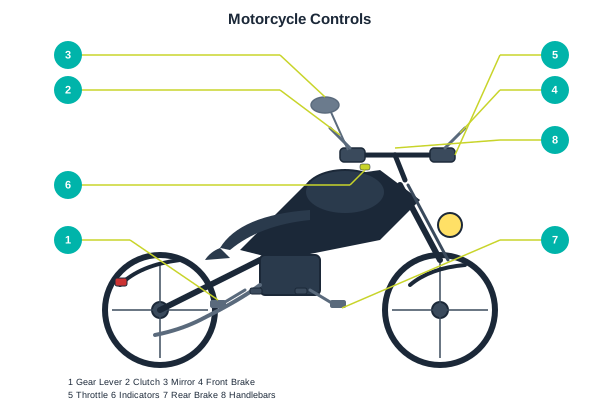
The 8 Motorcycle Controls
1. Gear Lever (left foot)
The gear lever is operated by the rider's left foot. It is located in front of the left foot peg. Press it down to shift into first gear from neutral, and use an upward motion to shift into higher gears. To change gears, you must use the gear lever together with the clutch lever.
2. Clutch Lever (left hand)
The clutch lever is located on the left handlebar. Squeeze it toward the handlebar to disengage the engine from the rear wheel, allowing you to change gears. Release it smoothly to re-engage. To change gears, use the clutch lever (2) together with the gear lever (1).
3. Mirror
Motorcycles have mirrors mounted on the handlebars (typically one on each side). They provide a view of traffic behind you. Check your mirrors frequently while riding and always before changing lanes, turning, or stopping.
4. Front Brake Lever (right hand)
The front brake lever is located on the right handlebar. Squeeze it toward the handlebar to apply the front brake. The front brake provides the majority of a motorcycle's stopping power. Apply it progressively and smoothly. Important: Never apply the front brake while the handlebars are turned, as this can cause the motorcycle to fall over.
5. Accelerator / Throttle (right hand twist grip)
The throttle is the right-hand grip on the handlebar. Twist it toward you to accelerate and increase engine speed. Release it to decelerate. The throttle should be operated smoothly to avoid sudden acceleration, which can cause loss of control.
6. Indicator Switch
The indicator switch is typically located on the left handlebar. It is a thumb-operated switch that activates the left or right turn signals. Unlike a car, motorcycle indicators do not cancel automatically — you must remember to switch them off manually after completing your turn.
7. Rear Brake Pedal (right foot)
The rear brake pedal is located in front of the right foot peg and is operated by the rider's right foot. Press it down to apply the rear brake. For safe and effective braking, use both the front brake (4) and the rear brake (7) together. Using the rear brake alone greatly increases your stopping distance.
8. Handlebars
The handlebars steer the motorcycle. They also house most of the hand-operated controls including the clutch lever, front brake lever, throttle, indicator switch, horn, headlight switch, and starter button. Grip the handlebars firmly but not too tightly, and steer smoothly.
Motorcycle-Specific Rules
- Helmet: Wearing a properly fastened, approved helmet is mandatory for both the rider and any passenger at all times while the motorcycle is in motion.
- Protective gear: While not legally required beyond the helmet, wearing protective clothing (jacket, gloves, boots, and trousers) is strongly recommended to reduce injury in a fall.
- Visibility: Motorcycles are smaller and harder for other drivers to see. Wear bright or reflective clothing, keep your headlight on at all times, and avoid riding in other vehicles' blind spots.
- Braking: To stop safely, always use both the front brake and the rear brake together. Never grab the front brake suddenly, especially on a wet or slippery surface.
6. Test Day Preparation
Passing the K53 test is not just about knowing the material — it is also about being properly prepared on the day. Many people fail not because they did not study, but because they forgot a document, arrived too late, or panicked during the test. Here is everything you need to do to ensure a smooth test day.
Document Checklist
Make sure you have all of the following documents ready the night before your test:
- Valid South African ID document (green bar-coded ID book, smart card ID, or valid temporary ID). Your ID must not be expired.
- Two passport-size ID photographs — recent colour photos with a white background. Many traffic departments have a photo booth on-site, but it is safer to bring your own.
- Eye test certificate — Get this done before your test date at Spec-Savers, Torga Optical, or any registered optometrist. Some traffic departments also conduct the eye test on-site, but this varies by location.
- Completed LL1 application form — This form is available at the traffic department. You can usually collect it in advance and fill it in at home to save time.
- Proof of residential address — A utility bill (electricity, water, or rates), bank statement, or cell phone account statement not older than 3 months. The name and address must match your ID.
- Test fee — Approximately R78. Some traffic departments accept cash only, while others also accept card payments. Bring both to be safe.
What to Expect on the Day
- Arrive early. At busy centres such as Randburg, Centurion, or Umhlanga, queues start forming before 7:00 AM. Getting there early means you'll be processed sooner and can complete your test while you are still fresh.
- You will queue to have your documents checked and verified by a clerk.
- You will then complete an eye test (if you have not already submitted an eye test certificate).
- You will pay the test fee and receive a receipt.
- You will wait until your name is called for the computer test. Wait times can range from 30 minutes to several hours depending on how busy the centre is.
- The test is conducted on a computer terminal. You will see one question at a time with multiple choice answers. The three sections are presented back to back.
Study Tips
- Study the morning of the test to refresh your memory. Go over road signs and rules one more time before you leave for the traffic department.
- Focus on road signs. This is the section where most people lose marks. Learn the colour and shape system, then memorise individual signs.
- Remember the 77% rule. You need 77% in each section, not as an overall average. A single weak section will fail you.
- Do not rush. Read each question carefully before selecting your answer. Many questions are designed to be tricky, with answers that look very similar.
- Bring water and a snack. Wait times can be very long at busy centres, and you want to stay hydrated and alert for your test.
- Use practice tests. The more practice tests you complete before the real test, the better prepared you will be. Our free practice tests mirror the format and difficulty of the actual K53 exam.
Ready to Test Your Knowledge?
Put what you have learned into practice with our free K53 mock tests.